Description
The Historical Event Behind the Expression
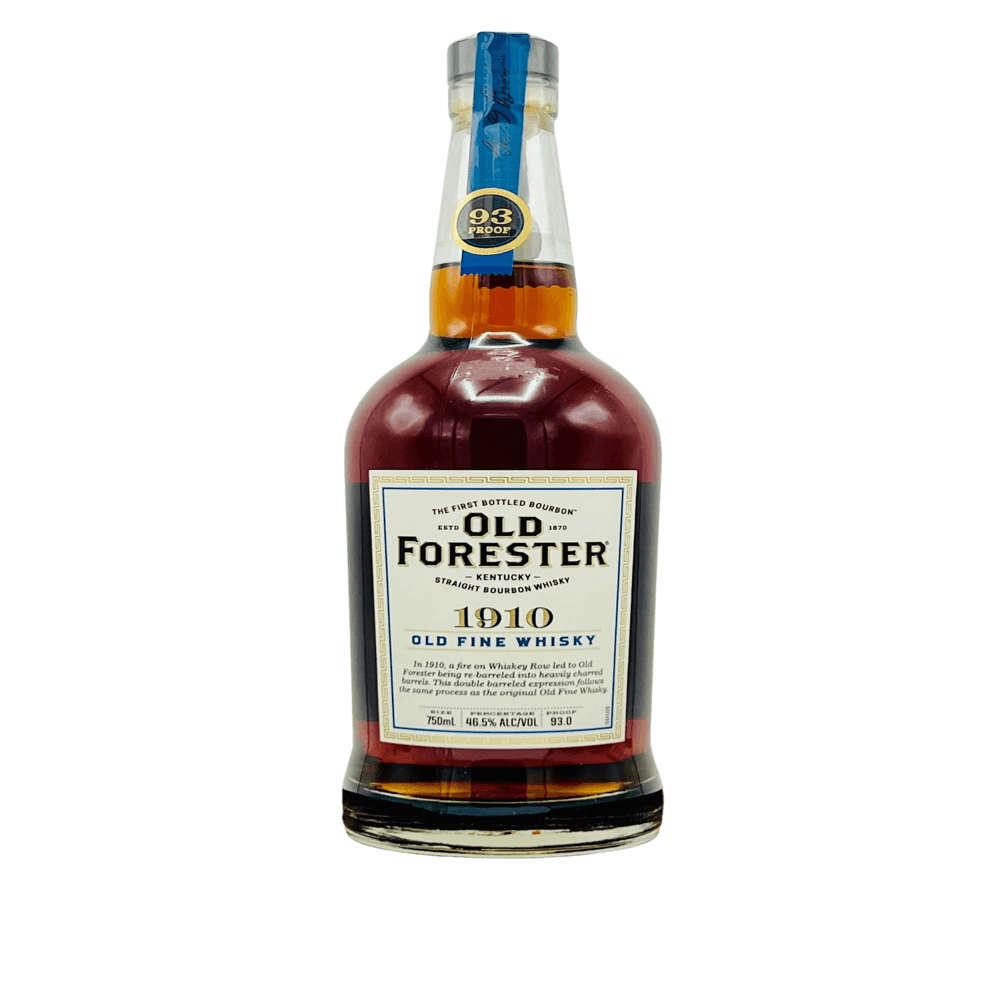
The 1910 expression in Old Forester’s Whiskey Row Series references a specific and documented production incident from that year — a barrel malfunction that prevented a batch of fully matured Old Forester bourbon from being bottled on its intended schedule. Rather than discard the affected batch, the distillery’s production team transferred the mature bourbon into a second new charred oak barrel to hold it until bottling could proceed.
What they discovered when that batch was eventually bottled was a bourbon meaningfully different from — and by most accounts superior to — the single-barrel matured product it had been before the transfer. The second barrel had added a layer of oak richness, caramelized wood character, and finish complexity that the original maturation had not produced. That accidental discovery became the deliberate production philosophy behind the 1910 expression — a double-barreled finish intentionally applied to fully mature Old Forester bourbon to recreate the flavor outcome that the 1910 incident first revealed.
The Double-Barreled Finish Process
Old Forester 1910 begins with fully mature Old Forester Kentucky straight bourbon — the same house mash bill distillate that forms the foundation of the core lineup — drawn from its primary barrel at the end of its initial maturation cycle. That mature bourbon is then transferred into a second new charred American white oak barrel for an additional secondary maturation period before bottling at 93 proof.
The second barrel interaction produces a measurably different flavor outcome than the first maturation alone. A new charred barrel’s most aggressive oak extraction occurs in its early contact with spirit — the initial weeks and months of interaction delivering the highest concentration of vanillin, tannin, and caramelized wood compounds. By transferring mature bourbon into a fresh barrel, the 1910 process subjects already-developed whiskey to a second wave of that aggressive early-contact oak extraction — layering additional caramelized wood richness on top of the complexity that the primary maturation produced.
Tasting Profile & Sensory Architecture
The nose opens with a noticeably richer and more oak-forward aromatic profile than any single-barrel Old Forester expression delivers — deep caramelized oak, dark vanilla, and a brown sugar note lead, supported by a dried stone fruit character and a subtle dark chocolate undertone that the secondary barrel contributes. The familiar Old Forester baking spice thread runs beneath the amplified wood aromatics.
On the palate, the double-barreled process announces itself immediately through a mid-palate richness and oak integration that single-maturation expressions cannot replicate. Caramelized oak, dark caramel, cinnamon, and a dark cherry note develop through the mid-palate with a cohesion and depth that reflects the deliberate layering of two separate oak maturation cycles. The 93 proof bottling sits at the precise threshold where the amplified oak character from the secondary barrel is carried cleanly without tipping into drying astringency. The finish is long, warm, and defined by lingering caramelized wood, dark chocolate, and a vanilla persistence that extends well past the swallow.
How Double-Barreling Differs From Wood Finishing
The double-barreled format of Old Forester 1910 is frequently conflated with the stave finishing programs used by producers like Maker’s Mark — but the two processes are meaningfully distinct in both method and flavor outcome. Stave finishing involves submerging individual oak staves directly into mature spirit in a tank or existing barrel — a targeted, controlled extraction of specific flavor compounds from a limited oak surface area over a defined finishing period.
Double-barreling transfers the entire volume of mature spirit into a full new charred barrel — subjecting it to the complete oak interaction surface, the full char layer filtration system, and the ambient temperature cycling of a second rickhouse maturation period. The result is a more comprehensive and integrated secondary oak development than stave finishing produces — less targeted in its flavor contribution but more complete in its interaction with the mature spirit’s existing flavor architecture.
The Whiskey Row Series Context
Old Forester’s Whiskey Row Series — the 1870 Original Batch, the 1897 Bottled in Bond, the 1910 Old Fine Whisky, and the 1920 Prohibition Style — is a four-expression lineup where each bottle references a historically documented production era or event in the brand’s 150-plus year continuous production history. The 1910 expression is the only Series member built on a specific production incident rather than a broader era — making it the most event-specific and narratively precise of the four expressions.
At 93 proof, the 1910 sits between the 1897 Bottled in Bond at 100 proof and the standard core lineup expressions in terms of proof intensity — a deliberate calibration that allows the double-barreled oak character to define the expression’s identity without the proof-driven heat that would compete with the secondary wood contribution at higher bottling strengths.
Comparative Position Within the Old Forester Lineup
For collectors building complete Old Forester portfolio sets, the 1910 occupies the finishing complexity tier — the expression that documents what a second new charred oak barrel maturation cycle adds to a fully developed Old Forester distillate. It delivers more oak-driven depth than the 100 Proof core expression and the 1870 Original Batch, but approaches that complexity through maturation layering rather than proof amplification — a fundamentally different production tool than the 1920’s high-proof barrel intensity.
When collectors buy Old Forester 1910 Bourbon through Allocated Bourbon Vault, they acquire the historical incident document — the expression that preserves and recreates the accidental discovery of 1910 as a deliberate, ongoing production achievement within the Whiskey Row Series framework.
Premium Packaging & Secure Delivery Protocol
Every order fulfilled through Allocated Bourbon Vault is processed under our multi-point authentication and secure dispatch protocol. Bottles are inspected for seal integrity, label condition, and fill level before dispatch.
All shipments are packed in reinforced, spirits-grade insulated cartons with tamper-evident outer sealing. Signature-required delivery is standard on all orders. Temperature-sensitive routing is applied during summer months at no additional cost. Insurance coverage is included on every shipment up to full declared value.
Transactional Vault FAQs
Q: What historical event does Old Forester 1910 reference?
A: The 1910 expression references a documented production incident from that year in which a barrel malfunction prevented a batch of fully matured Old Forester bourbon from being bottled on schedule. The production team transferred the affected batch into a second new charred oak barrel to hold it — and discovered when the batch was eventually bottled that the second barrel had added a layer of oak richness and complexity that the original maturation had not produced. That accidental discovery became the deliberate double-barreled production philosophy behind the 1910 expression.
Q: How does double-barreling differ from stave finishing programs like Maker’s Mark 46?
A: Stave finishing submerges individual oak staves directly into mature spirit — a targeted extraction of specific flavor compounds from a limited oak surface area over a defined finishing period. Double-barreling transfers the entire volume of mature spirit into a complete new charred barrel, subjecting it to the full oak interaction surface, char layer filtration, and ambient temperature cycling of a second rickhouse maturation period. The result is a more comprehensive secondary oak development than stave finishing produces.
Q: Why is Old Forester 1910 bottled at 93 proof rather than a round number?
A: The 93 proof reflects the natural concentration of the double-barreled mature bourbon at the point of bottling — a non-round proof that signals the distillery’s decision to bottle at or near the natural maturation strength of the selected barrels rather than reducing aggressively to a round-number marketing target. It also represents a deliberate calibration — high enough to carry the secondary oak character with weight, low enough to prevent proof-driven heat from competing with the double-barreled wood complexity.
Q: Does Old Forester 1910 carry an age statement?
A: No. Like the other NAS expressions in the Whiskey Row Series, the 1910 is blended from mature barrels selected against a specific sensory benchmark rather than a minimum age threshold. The defining production variable for this expression is the double-barreled finish rather than barrel age — the second new charred oak maturation cycle is the primary flavor differentiator, and the selection criteria for contributing barrels prioritizes compatibility with that secondary oak development over age statement eligibility.
Q: How does Old Forester 1910 compare to the 1920 Prohibition Style in the Whiskey Row Series?
A: The 1910 and 1920 represent the two most distinctive expressions in the Whiskey Row Series but achieve their distinction through fundamentally different production tools. The 1920 delivers intensity through proof — 115 proof barrel-forward concentration that makes it the boldest expression in the series. The 1910 delivers complexity through maturation — a double-barreled secondary oak development that adds caramelized wood depth and finish richness at a more measured 93 proof. The two expressions are complementary rather than hierarchical within the series.
Q: How long will this allocation remain available?
A: Inventory is updated in real time and no quantity holds are placed without completed checkout. Whiskey Row Series expressions move consistently across collector markets due to their historical provenance and series collectibility. We recommend securing your bottle without delay.