Description
The Producer Behind the Bottle
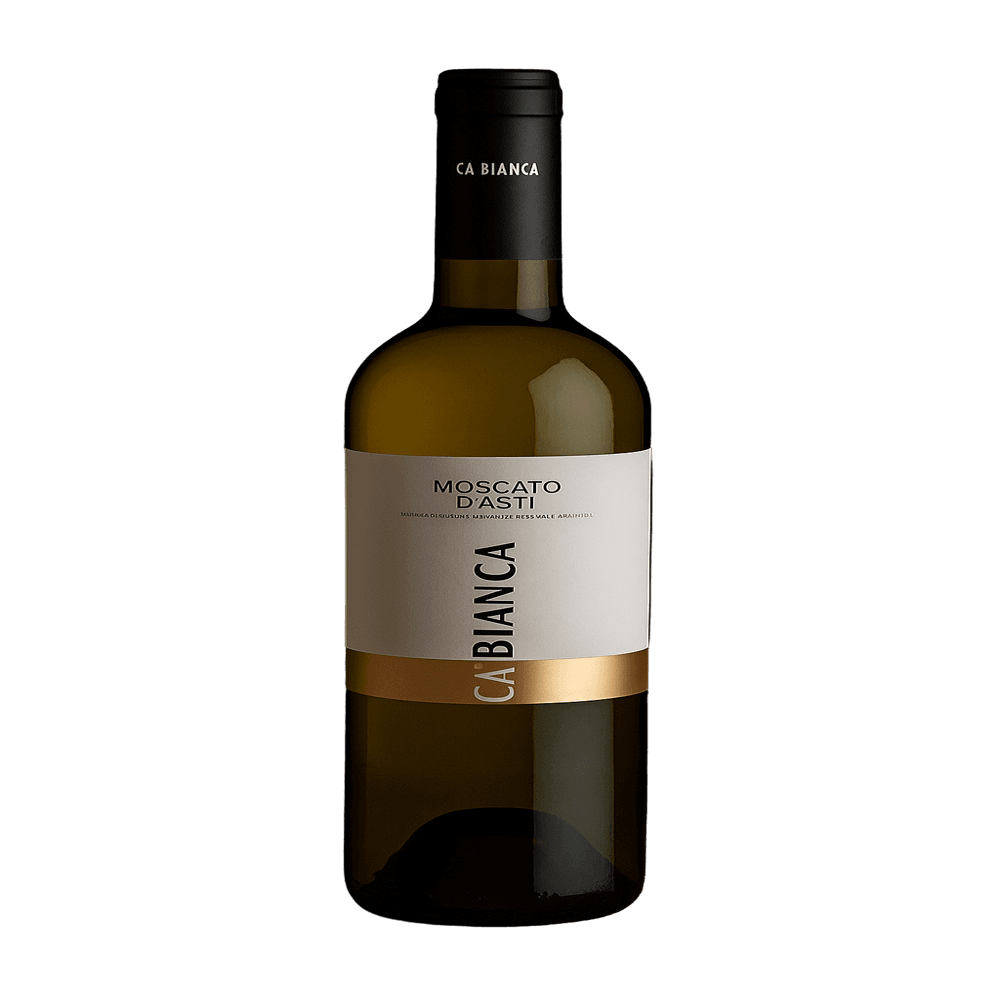
Ca’ Bianca is a historic Piedmontese estate winery with roots in the Asti zone’s winemaking tradition — a producer that has built its reputation on translating the specific terroir of its hillside vineyard parcels into wines that express the Moscato Bianco variety with clarity, freshness, and aromatic precision that defines the Moscato d’Asti DOCG at its best.
The estate operates under the Gruppo Italiano Vini umbrella — one of Italy’s most significant premium wine portfolio groups — bringing production infrastructure, quality control standards, and international distribution capability to its Piedmont operations without compromising the small-producer sensibility and terroir focus that Ca’ Bianca has maintained across its Asti zone winemaking program.
The Moscato d’Asti DOCG Distinction
Moscato d’Asti is one of Italy’s most precisely defined and rigorously enforced wine denominations — a DOCG designation that requires Moscato Bianco grape sourcing exclusively from within the delimited Asti zone, a maximum alcohol level of 5.5% ABV enforced through arrested fermentation, a minimum residual sugar level that ensures the characteristic sweetness of the style, and a natural perlage produced through single fermentation in pressurized tanks without secondary fermentation or added carbonation.
That regulatory framework distinguishes genuine Moscato d’Asti from the broader and less regulated Asti Spumante category — the DOCG designation signals a more delicate, less effervescent, lower-alcohol, and more aromatically precise expression of the Moscato Bianco variety than its more commercially produced sparkling counterpart. The maximum 5.5% ABV requirement is enforced at the DOCG level — not a stylistic choice by individual producers, but a regulatory standard that defines the category.
The Moscato Bianco Grape & Asti Zone Terroir
Moscato Bianco — Muscat Blanc à Petits Grains in French ampelography — is one of the oldest cultivated grape varieties in recorded winemaking history and the exclusive variety behind the Moscato d’Asti DOCG. In the Asti zone’s specific growing conditions — calcareous clay and sandy soils on steep south-facing hillside exposures, the moderating influence of the Apennine mountain barrier on summer temperatures, and the area’s characteristic late-summer foggy mornings that preserve grape acidity through the final ripening phase — Moscato Bianco achieves an aromatic concentration and natural sweetness that no other region consistently replicates.
Ca’ Bianca’s vineyard sourcing within the Canelli and Santo Stefano Belbo communes prioritizes the hillside parcels where these terroir conditions are most pronounced — producing a Moscato d’Asti with the aromatic intensity and structural freshness that distinguishes the best subzone expressions from the broader DOCG category.
The Arrested Fermentation Method
The 5.5% ABV of Ca’ Bianca Moscato d’Asti is the natural and legally mandated result of arrested fermentation — the production technique that defines the Moscato d’Asti style and produces its characteristic combination of sweetness, gentle effervescence, and low alcohol simultaneously. Fermentation begins in temperature-controlled pressurized tanks, converting a portion of the Moscato Bianco’s natural grape sugar to alcohol and carbon dioxide before the winemaker arrests the process by chilling the fermenting must to below the temperature at which yeast remain active.
The carbon dioxide produced during fermentation is retained under the tank’s pressure rather than released — producing the characteristic gentle perlage of Moscato d’Asti naturally, without secondary fermentation or added carbonation. The result is a wine where residual grape sugar, natural effervescence, and primary fruit aromatics are all preserved in their freshest and most expressive state — a combination that the Moscato d’Asti DOCG’s strict regulatory framework protects from compromise.
Tasting Profile & Sensory Architecture
The nose opens with an immediacy and aromatic generosity that is the defining sensory characteristic of great Moscato d’Asti — fresh white peach, ripe apricot, orange blossom, and acacia honey rise from the glass with an expressiveness that requires no warming or aeration. A delicate lemon zest note and a subtle rose petal character develop behind the primary fruit and floral aromatics.
On the palate, the gentle perlage lifts the natural sweetness and prevents the residual sugar from reading as heavy — the carbonation providing a textural freshness that distinguishes Moscato d’Asti from still sweet wines at comparable sugar levels. Fresh peach, mandarin, and a light apricot preserve note develop through the mid-palate with a delicacy and precision that the 5.5% ABV positively enables — the low alcohol allowing the aromatic and fruit compounds to express without the warmth that higher ABV introduces in sweeter wine styles. The finish is clean, refreshing, and defined by lingering peach blossom and honey — inviting rather than demanding, and resolved cleanly without any cloying residue.
Serving Occasions & Pairing Applications
Ca’ Bianca Moscato d’Asti performs across a broader range of serving occasions than its sweet wine classification immediately suggests. At 5.5% ABV, it is genuinely sessionable in a way that almost no other premium wine expression achieves — lower in alcohol than most table wines, more aromatically expressive than most low-ABV alternatives, and sweet enough to anchor dessert pairings without the weight that higher-concentration dessert wines impose.
As an aperitivo served well-chilled before a meal, the effervescence and aromatic freshness function as a palate-engaging welcome pour without the alcohol load that compromises appetite. Paired with fresh fruit desserts, light pastries, almond-based confections, and soft fresh cheeses, the Moscato d’Asti’s sweetness and effervescence complement rather than compete. When you buy Ca’ Bianca Moscato d’Asti through Allocated Bourbon Vault, that occasion versatility is one of the expression’s most immediately deployable practical qualities.
Comparative Position Within the Moscato Category
Within the broader Italian Moscato category, Ca’ Bianca Moscato d’Asti occupies the DOCG premium tier — above generic Moscato table wines and non-DOCG Asti Spumante expressions in terms of regulatory stringency, aromatic precision, and terroir specificity. The DOCG designation on the label communicates a production standard and geographic commitment that the broader Moscato category cannot match.
For collectors and hospitality programs building Italian wine selections that include a premium Moscato expression, the DOCG designation, the Asti zone hillside sourcing, and Ca’ Bianca’s established production reputation combine to make this the most credentialed and defensible choice in the sweet Italian sparkling white wine category at its price tier.
Storage & Serving Protocol
Ca’ Bianca Moscato d’Asti is designed for consumption within one to two years of vintage — the fresh primary fruit and floral aromatics that define the Moscato d’Asti DOCG style are at their most vibrant in the wine’s youth and diminish with extended bottle age. Store unopened bottles in a cool, dark environment at approximately 8–12°C, away from light and vibration.
Serve well-chilled at 6–8°C — cold enough to preserve aromatic clarity and enhance the refreshing quality of the natural perlage. Once opened, consume within one to two days under refrigeration with a sparkling wine stopper to preserve residual carbonation and aromatic freshness.
Premium Packaging & Secure Delivery Protocol
Every order fulfilled through Allocated Bourbon Vault is processed under our multi-point authentication and secure dispatch protocol. Ca’ Bianca Moscato d’Asti bottles are inspected for closure integrity, DOCG certification seal condition, label authenticity, and fill level before dispatch.
All shipments are packed in reinforced, temperature-controlled cartons with tamper-evident outer sealing. Signature-required delivery is standard on all orders. Cold-chain routing is applied where seasonal ambient temperatures require it. Insurance coverage is included on every shipment up to full declared value.
Transactional Vault FAQs
Q: What is the difference between Moscato d’Asti DOCG and Asti Spumante?
A: Both are produced from Moscato Bianco grapes in the Asti zone of Piedmont, but the two denominations are meaningfully distinct. Moscato d’Asti DOCG is delicately sparkling — frizzante — with a maximum 5.5% ABV, lower effervescence, and a more intensely aromatic, terroir-focused character. Asti Spumante is fully sparkling — spumante — with higher effervescence, higher permitted alcohol, and a more commercially produced profile. The DOCG designation signals the more refined and regulated expression of the two.
Q: Why is Ca’ Bianca Moscato d’Asti only 5.5% ABV?
A: The 5.5% maximum ABV is a regulatory requirement of the Moscato d’Asti DOCG denomination — not a stylistic choice by individual producers. Fermentation is arrested before completion by chilling the fermenting must, preserving both residual grape sugar and the natural carbonation developed during fermentation. The resulting low alcohol is the honest consequence of that regulated production method rather than a reduction or dilution.
Q: Should Ca’ Bianca Moscato d’Asti be consumed young or cellared?
A: Consumed young — ideally within one to two years of vintage. The fresh primary fruit and floral aromatics that define the Moscato d’Asti style are at their most vibrant and expressive in the wine’s youth. Extended cellaring diminishes rather than develops the character of this wine style. Purchase to enjoy promptly, serve well-chilled at 6–8°C, and consume within one to two days of opening under refrigeration.
Q: How does Ca’ Bianca Moscato d’Asti compare to Castello del Poggio Moscato?
A: Both are Piedmontese Moscato expressions from the Asti zone built on the Moscato Bianco variety and the arrested fermentation production method. Ca’ Bianca carries the Moscato d’Asti DOCG designation — the more stringently regulated and geographically specific denomination — with a maximum 5.5% ABV and a hillside terroir sourcing focus in the Canelli and Santo Stefano Belbo subzones. Castello del Poggio Moscato delivers a comparable aromatic profile with slightly higher alcohol. Both deliver genuine Piedmont Moscato character — the DOCG designation on Ca’ Bianca signals the more precisely regulated production standard.
Q: Is Ca’ Bianca Moscato d’Asti appropriate as a gift for non-wine drinkers?
A: Yes — it is one of the most broadly accessible and immediately appealing premium wine gift choices available. The DOCG designation communicates quality credibly. The peach, apricot, and floral aromatic profile has genuine cross-demographic appeal. The 5.5% ABV makes it appropriate for recipients with low alcohol tolerance. And the delicate effervescence and light sweetness deliver an immediately pleasurable experience that requires no prior wine category knowledge to appreciate.
Q: How long will this allocation remain available?
A: Inventory is updated in real time and no quantity holds are placed without completed checkout. We recommend securing your bottle without delay.