Description
The House Behind the Bottle
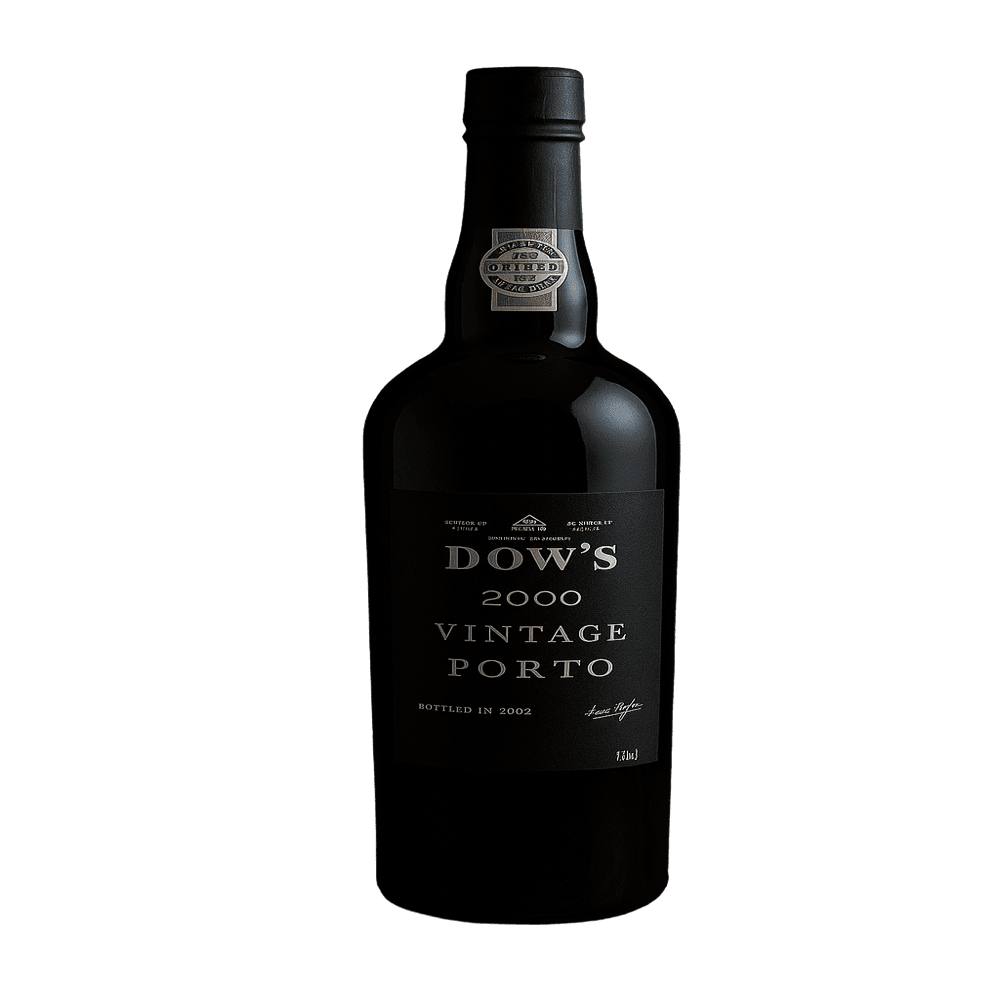
Dow’s is one of the oldest and most respected Port houses in the Douro Valley — a firm with documented production history stretching back to 1798 and a reputation built specifically on the production of dry-finishing, structured vintage Ports that age more gracefully and develop more complexity over extended bottle time than the sweeter, more immediately approachable styles favored by some competing houses.
The firm operates under the Symington Family Estates umbrella — the most significant single family ownership group in the Port trade, also responsible for Graham’s, Warre’s, and Quinta do Vesuvio among others. That family stewardship has maintained Dow’s production philosophy across generations without the commercial pressure to soften or accelerate the house style that corporate ownership structures often impose.
The 2000 Vintage in the Douro
The 2000 vintage in Portugal’s Douro Valley was widely declared by leading Port houses as one of the finest of its decade — a year that combined the warm, dry summer conditions necessary for full phenolic ripeness with the moderate autumn temperatures that preserve acidity and allow gradual, even maturation of the grape skins that contribute color, tannin, and flavor complexity to vintage Port.
Dow’s declared the 2000 vintage, releasing a wine that received exceptional critical reception at release and has continued to develop favorably across its subsequent two decades of bottle age. At over twenty years from vintage, the 2000 Dow’s has moved well past the closed, tannic phase that characterizes young vintage Port and entered the complex, fully integrated maturity window that great Douro vintages eventually produce.
What Two Decades of Bottle Age Produces
Vintage Port undergoes a fundamentally different aging trajectory than still table wine. The fortification that brings the wine to 20% ABV arrests fermentation, preserving residual sugar and fruit concentration while providing the alcohol framework necessary for extended maturation. In bottle, that concentration slowly evolves — primary fruit compounds transforming into dried fruit complexity, primary tannins polymerizing into the silky, integrated structure that defines mature vintage Port.
At twenty-plus years, Dow’s 2000 has completed the most demanding phase of that evolution. The aggressive tannins that made the wine formidable at release have integrated. The primary blackberry and plum fruit has transformed into dried fig, prune, and dark chocolate complexity. The house’s characteristic dry-finishing structure — which makes Dow’s vintage Ports among the most age-worthy in the trade — remains as the backbone, providing length and definition without the sweetness that softer house styles retain into maturity.
Tasting Profile & Sensory Architecture
The nose opens with the layered complexity that only genuine bottle age in a great vintage produces — dried fig, dark plum preserve, aged leather, and a subtle tobacco note that signals the wine’s maturity immediately. A dark chocolate undercurrent and a faint walnut character develop behind the primary dried fruit aromatics as the wine opens in the glass.
On the palate, the 20% ABV fortification provides a warm, structured framework for the concentrated dried fruit, dark chocolate, and spice development that twenty years of bottle maturation has produced. The tannins — once the defining structural challenge of this wine — are now fully integrated and silky, providing length and grip without any of the astringency that characterized the wine at release. The finish is very long, dry-edged by Dow’s house style, and defined by dark chocolate, leather, and a persistent dried fruit sweetness that carries well past the swallow and evolves in the glass over an extended tasting session.
Decanting Protocol & Serving Guidance
A vintage Port of this age and structure requires careful decanting before serving — a non-negotiable step that separates the bottle’s sediment from the wine and allows the compressed bottle-aged aromatics to open fully in contact with oxygen. Sediment formation in a twenty-plus year vintage Port is expected and desirable — it is the physical evidence of the tannin polymerization that has been occurring in bottle since release.
Stand the bottle upright for twenty-four to forty-eight hours before serving to allow sediment to settle to the bottom. Decant slowly over a light source — a candle or torch placed behind the bottle’s shoulder — stopping when the sediment reaches the neck. Allow the decanted wine to open for thirty to sixty minutes before the first pour. Serve at 16–18°C — slightly below standard red wine serving temperature — to preserve the aromatic complexity while allowing the concentrated fruit and chocolate notes to express fully.
Cellaring Potential & Current Drinking Window
The 2000 Dow’s Vintage Port is currently in its optimal drinking window — a plateau of maturity that great Douro vintages from leading houses maintain for a decade or more rather than reaching a sharp peak and declining rapidly. The wine’s structural acid backbone and residual sugar concentration provide the preservation framework for continued development through the early 2030s under appropriate storage conditions.
Collectors who buy Dow’s Vintage Port 2000 through Allocated Bourbon Vault are acquiring a bottle that is ready to drink now at its full complexity ceiling — but also capable of rewarding additional patience for those who choose to cellar further. Every bottle in our vault has been stored under temperature-controlled conditions from acquisition to dispatch, ensuring the bottle’s maturation history has not been compromised by improper storage at any point in the chain.
Rarity & Provenance of Mature Vintage Port
Mature vintage Port from declared vintages of genuine quality represents one of the most structurally scarce categories in the collected wine market. Unlike spirits, wine production is vintage-constrained — the 2000 growing season produced a finite volume of grapes, a finite volume of wine, and a finite number of bottles that has been diminishing through consumption for over two decades.
Every bottle of 2000 Dow’s Vintage Port that has been opened since release reduces the remaining inventory permanently. What exists today is what remains — and the combination of critical acclaim, house reputation, and declared vintage status ensures that demand for remaining inventory consistently exceeds supply. When you buy Dow’s Vintage Port 2000 through Allocated Bourbon Vault, provenance documentation and storage condition history are available for every bottle in our vault inventory.
Premium Packaging & Secure Delivery Protocol
Every order fulfilled through Allocated Bourbon Vault is processed under our multi-point authentication and secure dispatch protocol. Dow’s Vintage Port bottles are inspected for cork integrity, capsule condition, fill level, label authenticity, and vintage accuracy before dispatch — with particular attention to the storage condition history and provenance documentation appropriate for a twenty-plus year bottle-aged wine.
All shipments are packed in reinforced, temperature-controlled cartons with tamper-evident outer sealing. Signature-required delivery is standard on all orders. Cold-chain routing is applied where seasonal ambient temperatures require it. Insurance coverage is included on every shipment up to full declared value.
Transactional Vault FAQs
Q: What does it mean for a Port house to “declare” a vintage?
A: A vintage declaration is a Port house’s formal decision to produce and release a vintage-dated wine from a specific harvest year — a decision made only in years where the house judges the grape quality exceptional enough to warrant the extended aging commitment that vintage Port requires. Not every year is declared by every house, and a declaration from a respected house like Dow’s carries significant quality signaling weight in the Port trade.
Q: Does the 2000 Dow’s Vintage Port require decanting?
A: Yes — decanting is essential, not optional, for a vintage Port of this age. Over twenty years of bottle maturation produces meaningful sediment from tannin polymerization. Stand the bottle upright for twenty-four to forty-eight hours before serving, then decant slowly over a light source, stopping when sediment reaches the neck. Allow thirty to sixty minutes of decanting time before the first pour for full aromatic opening.
Q: Is the 2000 vintage still within its drinking window?
A: Yes. The 2000 Dow’s Vintage Port is currently in its optimal drinking window — a maturity plateau that the wine’s structural acid backbone and residual sugar concentration sustain through the early 2030s under appropriate storage. The wine is at full complexity now and does not require further cellaring, but will reward additional patience for collectors who choose to hold.
Q: How has this bottle been stored prior to dispatch?
A: Every bottle of mature vintage Port in our vault is stored under temperature-controlled conditions from acquisition to dispatch — maintained at 12–14°C with controlled humidity and minimal vibration. Provenance documentation covering the bottle’s storage history from our acquisition point forward is available for each listing upon request before purchase completion.
Q: How does Dow’s house style differ from other Port houses?
A: Dow’s is recognized specifically for producing dry-finishing, structured vintage Ports — a house style that prioritizes tannin architecture and extended aging potential over immediate sweetness and approachability. Compared to Graham’s or Fonseca, Dow’s vintage Ports tend toward a more austere, complex maturity profile that rewards patience and distinguishes itself clearly from sweeter house styles in extended bottle age comparisons.
Q: How long will this allocation remain available?
A: Mature vintage Port from declared years represents genuinely finite and permanently diminishing inventory. Every bottle consumed globally reduces what remains. Stock is updated in real time and no quantity holds are placed without completed checkout. We strongly recommend securing your bottle without delay — this inventory cannot be replenished.