Description
The Distillery Behind the Bottle
Heaven Hill Distillery is the largest independent family-owned bourbon producer in the United States — a Bardstown, Kentucky operation holding the second-largest aging bourbon inventory in Kentucky after Brown-Forman, with over one million barrels maturing across its extensive rickhouse network at any given time. That inventory depth is the singular production prerequisite that makes a twenty-one-year single barrel expression possible as a consistent release rather than a one-time anomaly.
No distillery with a smaller aging inventory can sustain a viable twenty-one-year single barrel program. The attrition rate of barrels between standard release ages and two decades of Kentucky maturation is substantial — the combination of angel’s share evaporation, over-oaking culls, and structural barrel failures eliminates the majority of candidates before they reach viability at this age statement. Heaven Hill’s million-barrel inventory provides the starting population from which the 21 Year program’s barrel candidates can be drawn without compromising the selection standards that define the expression.
Twenty-One Years — The Outer Edge of Kentucky Maturation
Twenty-one years in new charred American white oak in Kentucky’s climate represents a maturation commitment that places this expression at the absolute outer boundary of what the state’s aggressive seasonal temperature cycling produces as viable, balanced bourbon. Scotland’s cooler, more stable climate allows Scotch whisky to age gracefully for thirty, forty, or fifty years with relatively predictable flavor development. Kentucky’s dramatic seasonal extremes — summer temperatures driving aggressive oak extraction, winter cold slowing maturation to allow integration — compress the maturation timeline dramatically and impose a hard ceiling beyond which extended aging produces diminishing returns and ultimately over-oaking.
That ceiling sits somewhere between eighteen and twenty-five years for most Kentucky barrels — and precisely where within that range each individual barrel falls depends on its specific rickhouse position, floor level, seasonal exposure history, and the particular interaction dynamics between its distillate and its specific char layer. The barrels that reach twenty-one years with their flavor integrity intact have navigated that maturation window with a structural resilience that the majority of Heaven Hill’s aging inventory does not possess.
The Selection Discipline Behind the 21 Year Program
The barrel selection process for Elijah Craig 21 Year is among the most rigorous and demanding applied to any regularly released American whiskey expression. Heaven Hill’s production team evaluates candidate barrels against a specific sensory benchmark — the balance between extended oak contribution and surviving fruit and grain character that defines viable ultra-long-aged bourbon rather than over-extracted, tannin-dominated whiskey.
A barrel that passes eighteen years of Kentucky maturation with its flavor balance intact faces additional risk in years nineteen through twenty-one — continued oak extraction that, if the tannin polymerization rate exceeds the fruit and grain character’s survival capacity, produces bitterness rather than complexity in the final three years. The barrels that clear the twenty-one-year selection threshold are those whose specific maturation dynamics have produced a tannin structure deep and integrated enough to carry the full weight of twenty-one years without tipping into the astringency that eliminates candidate barrels from the program.
Tasting Profile & Sensory Architecture
The nose opens with an aromatic complexity that twenty-one years of barrel contact produces and no amount of younger distillate manipulation replicates — dark dried fruit, aged leather, antique oak, and a concentrated dark chocolate note lead with a depth and integration that signals immediately the extraordinary maturation behind the glass. A subtle tobacco character, a faint walnut note, and a dried citrus peel undertone develop as the wine opens — aromatic layers that accumulate only through genuine long-term barrel time.
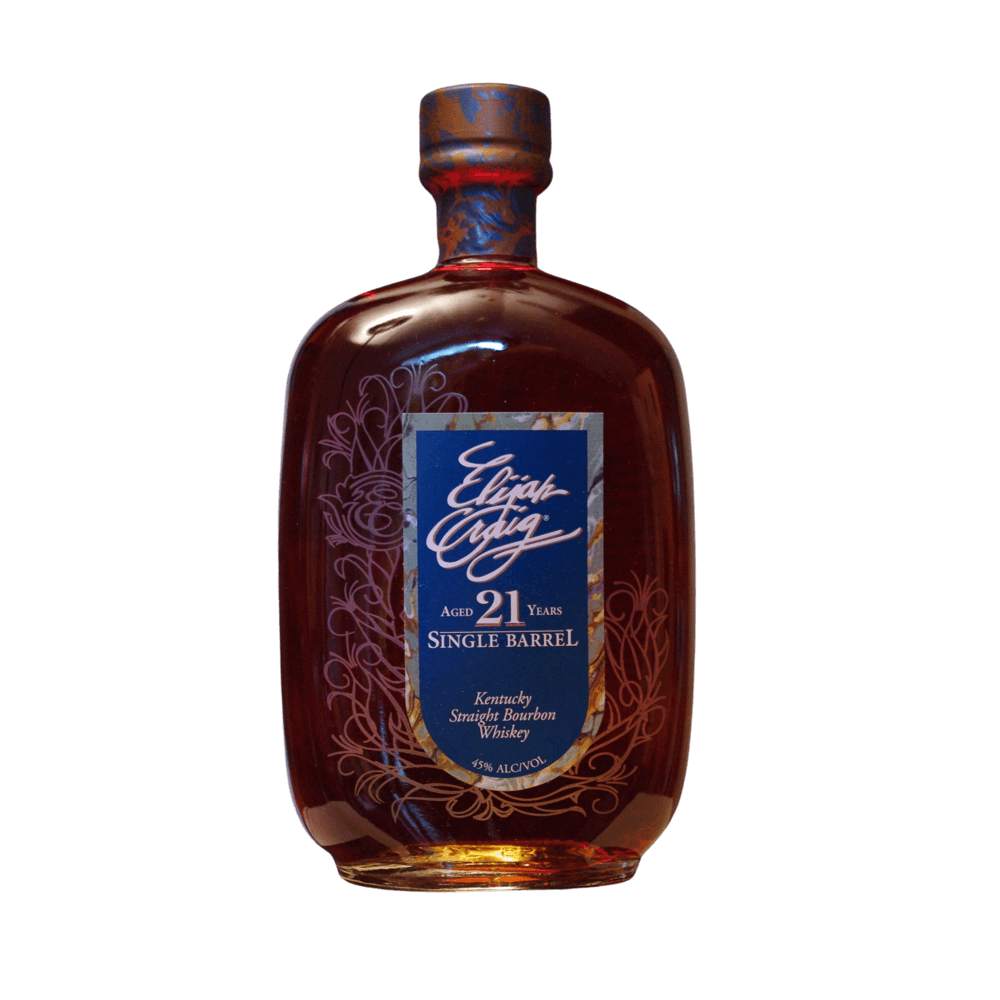
On the palate, twenty-one years of Kentucky rickhouse aging delivers the most complete and integrated tannin structure available in a single barrel American bourbon expression at any price point. Dark fruit preserve, espresso, dark chocolate, and aged leather build through the mid-palate with a deliberateness and cohesion that rewards patient, attentive sipping above all other consumption approaches. The 94 proof bottling is precisely and necessarily calibrated — enough alcohol to carry the deeply integrated oak tannins and concentrated fruit complexity without masking either, while avoiding the tannin amplification that barrel strength bottling would impose on a twenty-one-year oak extraction profile. The finish is extraordinarily long, dry, and structured — dark chocolate, aged leather, and a persistent dried fruit warmth carrying well past the swallow and evolving in the glass across an extended tasting session in a way that younger expressions simply cannot sustain.
The 94 Proof Bottling Decision
The decision to bottle Elijah Craig 21 Year at 94 proof — four proof points above the 18 Year’s 90 proof bottling — reflects a specific and deliberate calibration to the twenty-one-year maturation profile’s tannin architecture. At twenty-one years, the oak tannin contribution to the spirit is at the maximum level that Heaven Hill’s selection discipline permits into the program. Those tannins are deeply integrated and structurally sound — but they require slightly more alcoholic backbone to carry cleanly through the mid-palate and into the finish without reading as drying or astringent.
The four additional proof points provide that backbone without approaching the proof level that would amplify the tannins beyond their integration point. It is a precise production decision that reflects institutional knowledge of how twenty-one-year Kentucky bourbon tannin structures interact with bottling proof — a calibration that the difference between the 18 Year at 90 proof and the 21 Year at 94 proof documents concretely.
Comparative Rarity & Market Context
When collectors buy Elijah Craig 21 Year Bourbon through Allocated Bourbon Vault, they are acquiring a bottle whose twenty-one-year age statement represents the most demanding production credential in the Elijah Craig lineup and one of the most extraordinary in the American whiskey category as a whole. The combination of a twenty-one-year verified age statement, single barrel bottling with full barrel traceability, and Heaven Hill’s production credibility creates a scarcity and provenance profile that commands collector attention independent of any secondary market pricing dynamics.
Very few Kentucky distilleries produce a twenty-one-year age-stated expression at all — and fewer still do so as a consistent, ongoing single barrel program rather than a one-time anomaly release from an exceptionally preserved outlier barrel. Heaven Hill’s inventory depth makes the consistency possible. The selection discipline makes the quality reliable. The twenty-one-year maturation commitment makes the result irreplaceable.
Collection Positioning & the Elijah Craig Age Statement Tier
Within the Elijah Craig age-stated single barrel hierarchy — the 18 Year and 21 Year expressions — the 21 Year sits at the absolute apex. It is the expression that documents what three additional years of Kentucky barrel maturation beyond the already exceptional 18 Year produces when the selection discipline and inventory depth of America’s largest independent bourbon producer are applied without compromise to the outer edge of viable Kentucky maturation.
For collectors building structured age-stated single barrel comparative sets, the side-by-side evaluation of Elijah Craig 18 Year against Elijah Craig 21 Year is one of the most instructive and revealing exercises available in the American whiskey category — three years of additional maturation on the same house mash bill from the same distillery producing a documentably and meaningfully different drinking experience.
Premium Packaging & Secure Delivery Protocol
Every order fulfilled through Allocated Bourbon Vault is processed under our multi-point authentication and secure dispatch protocol. Bottles are inspected for seal integrity, barrel number label accuracy, age statement verification, and fill level before dispatch.
All shipments are packed in reinforced, spirits-grade insulated cartons with tamper-evident outer sealing. Signature-required delivery is standard on all orders. Temperature-sensitive routing is applied during summer months at no additional cost. Insurance coverage is included on every shipment up to full declared value.
Transactional Vault FAQs
Q: Why is twenty-one years considered the outer edge of viable Kentucky bourbon maturation?
A: Kentucky’s dramatic seasonal temperature swings — hot summers driving aggressive oak extraction, cold winters allowing integration — compress the bourbon maturation timeline and impose a practical ceiling beyond which extended aging produces diminishing returns and ultimately over-oaking. Most Kentucky barrels that survive to twenty-one years without over-extraction do so because of specific rickhouse position, floor level, and barrel interaction dynamics that a minority of barrels possess. The selection attrition rate between standard release ages and twenty-one years eliminates the majority of candidate barrels from consideration.
Q: How does Elijah Craig 21 Year differ from the 18 Year expression?
A: Both share the Heaven Hill distillery infrastructure, the Elijah Craig house mash bill, and the single barrel bottling format. The twenty-one-year expression adds three additional years of Kentucky rickhouse maturation — producing measurably deeper tannin polymerization, more pronounced dried fruit and chocolate complexity, a greater leather and espresso character, and a finish persistence that extends significantly beyond the already exceptional 18 Year. The 94 proof bottling versus the 18 Year’s 90 proof reflects the additional alcoholic backbone required to carry the deeper twenty-one-year tannin structure cleanly.
Q: Why is Elijah Craig 21 Year bottled at 94 proof rather than 90 proof like the 18 Year?
A: The four additional proof points reflect a deliberate calibration to the twenty-one-year maturation profile’s tannin architecture. At twenty-one years, the deeply integrated oak tannins require slightly more alcoholic backbone to carry cleanly through the mid-palate without reading as drying. The 94 proof provides that backbone without approaching the level that would amplify the tannins beyond their integration point — a precise production decision reflecting institutional knowledge of how ultra-long-aged Kentucky bourbon tannin structures interact with bottling proof.
Q: How does Heaven Hill sustain a consistent twenty-one-year single barrel program?
A: Heaven Hill’s position as the largest independent family-owned bourbon producer in the United States — with over one million barrels maturing across its Bardstown rickhouse network — provides the starting inventory population from which twenty-one-year viable barrels can be drawn without compromising selection standards. No distillery with a smaller aging inventory can sustain a program at this age statement with equivalent consistency. Scale is the prerequisite; selection discipline delivers the quality.
Q: Is this bottle sourced from an authorized distributor?
A: Yes. Every bottle in our vault is sourced exclusively through licensed, authenticated primary distribution channels. No secondary market or third-party broker sourcing is used at any point in our fulfillment process.
Q: How long will this allocation remain available?
A: Twenty-one-year single barrel expressions represent the most structurally scarce inventory category in our vault. Per-barrel bottle yield at this age statement — after twenty-one years of angel’s share evaporation — is a fraction of standard release barrel yields. Stock is updated in real time and no quantity holds are placed without completed checkout. We strongly recommend securing your bottle without delay.