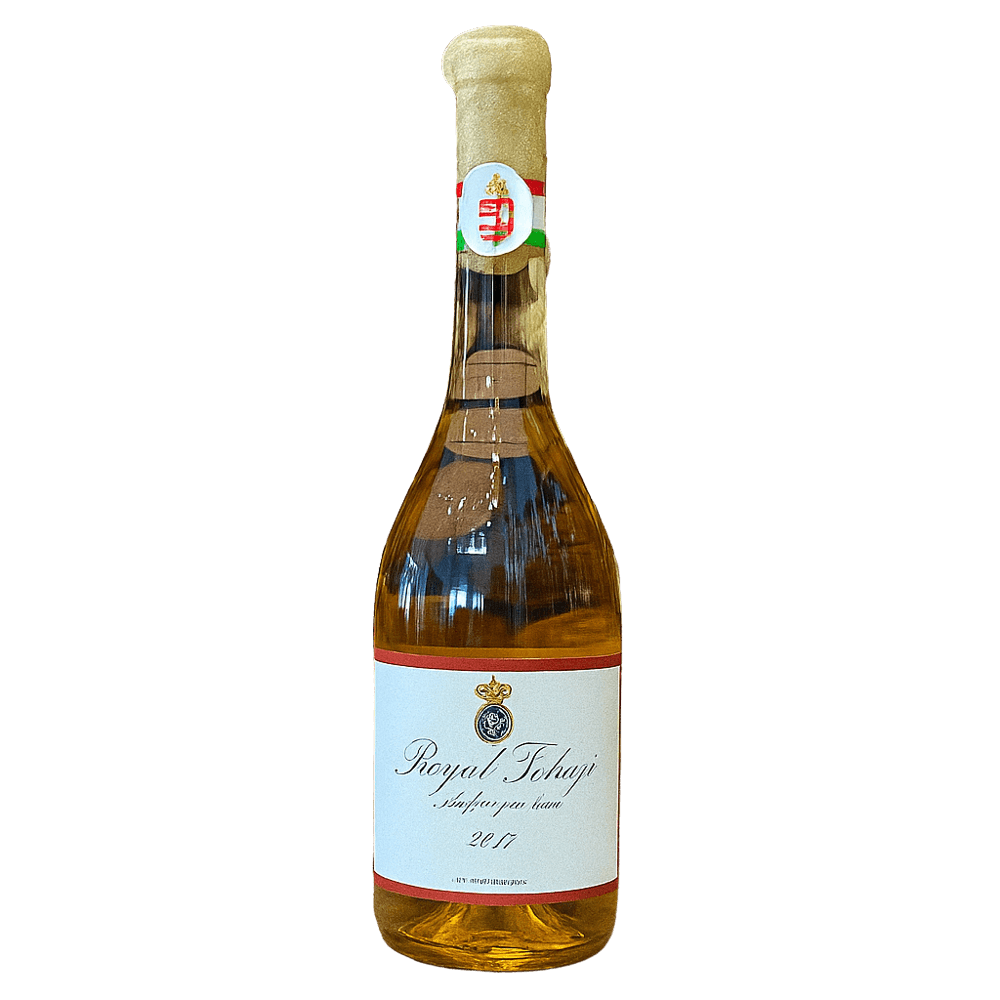
Description
The Producer Behind the Bottle
Royal Tokaji is the most historically significant and internationally recognized producer in Hungary’s Tokaj wine region — a company founded in 1990 by a consortium that included wine writer Hugh Johnson, with the explicit mission of reviving the Tokaj region’s pre-Communist winemaking tradition after four decades of state-controlled production had eroded its quality credentials.
The company owns or controls some of the most prestigious classified vineyard sites in the region, including parcels in the First Growth Nyulászó and Mézes Mály vineyards. Its production philosophy prioritizes single vineyard transparency, minimal intervention, and the preservation of the traditional Aszú production method that made Tokaji one of the most prized wines in European royal courts for centuries.
What Tokaji Aszú Actually Is
Tokaji Aszú is not simply a sweet wine — it is a precisely regulated, historically documented wine style produced through one of the most labor-intensive and climatically dependent production methods in the world. The process begins with botrytis cinerea — the noble rot fungus — which selectively infects ripe Furmint and Hárslevelű grapes on the vine, concentrating their sugars, acids, and flavor compounds through controlled dehydration.
Those botrytis-affected grapes — called Aszú berries — are harvested individually by hand during multiple passes through the vineyard as each berry reaches optimal infection. The harvested Aszú berries are then macerated in base wine or fermenting must before pressing, fermentation, and extended aging in the region’s distinctive underground cellars carved into volcanic tuff. The result is a wine of extraordinary concentration, complexity, and aging potential that no other production method replicates.
The 2017 Vintage in Tokaj
The 2017 vintage in Hungary’s Tokaj region produced conditions highly favorable for Aszú production — warm, dry summer conditions building excellent base grape ripeness, followed by the autumn humidity fluctuations that encourage selective botrytis development on the Furmint and Hárslevelű varieties that define the region’s white wine identity.
Vintages that successfully combine pre-botrytis base ripeness with controlled noble rot development — as 2017 did — produce Aszú wines with both the primary fruit concentration and the secondary botrytis-derived complexity that define great Tokaji. The 2017 Royal Tokaji Aszú represents a vintage where those conditions aligned to produce a wine with both immediate approachability and the structural acid backbone required for extended cellaring.
Tasting Profile & Sensory Architecture
The nose opens with the classic Royal Tokaji aromatic signature — fresh apricot, orange marmalade, and a concentrated honey note that signals the botrytis contribution immediately. A subtle dried saffron character and a light oxidative note from cellar aging add complexity behind the primary fruit aromatics.
On the palate, the 2017 vintage delivers the balance of sweetness and acidity that defines great Tokaji Aszú — the residual sugar concentration from the Aszú berry maceration providing richness and texture, while the naturally high acidity of Furmint cuts through that sweetness to produce a finish that is long, clean, and never cloying. Apricot preserve, mandarin peel, and a subtle mineral character from the region’s volcanic soils develop through the mid-palate. The finish is very long, defined by honeyed sweetness, dried citrus, and a saline mineral fade that extends well past the swallow.
Four Centuries of Royal Provenance
Tokaji Aszú’s historical prestige is not a modern marketing construction — it is a documented four-century record of recognition at the highest levels of European culture and power. Louis XIV of France described Tokaji as the wine of kings and the king of wines. Peter the Great of Russia maintained standing purchase orders for the region’s production. The Austro-Hungarian Empire protected Tokaj’s appellations with legal demarcation as early as 1737 — predating the Bordeaux classification system by over a century.
Collectors who buy Royal Tokaji Aszú 2017 through Allocated Bourbon Vault are acquiring a bottle connected to that unbroken historical lineage — produced by the region’s most prominent revival producer on some of its most historically significant vineyard sites.
Cellaring Potential & Serving Protocol
Great Tokaji Aszú from a quality producer and a favorable vintage is among the longest-lived wine styles produced anywhere in the world. Royal Tokaji Aszú expressions from strong vintages regularly develop and improve across two to three decades of cellaring under appropriate conditions — cool, dark, humidity-controlled storage at 12–14°C with minimal vibration.
The 2017 vintage’s combination of fruit concentration and structural acidity suggests meaningful aging potential through the mid-2030s and beyond. Serving temperature should be 10–12°C — cold enough to preserve aromatic clarity without suppressing the complexity that the botrytis concentration and cellar aging have produced. The 500ml format is specifically calibrated for dessert-course or contemplative tasting rather than full-bottle consumption, making it the appropriate serving unit for this wine style.
Premium Packaging & Secure Delivery Protocol
Every order fulfilled through Allocated Bourbon Vault is processed under our multi-point authentication and secure dispatch protocol. Royal Tokaji bottles are inspected for cork integrity, capsule condition, label authenticity, and fill level before dispatch — with particular attention to vintage label accuracy given the collectible nature of vintage-specific Aszú releases.
All shipments are packed in reinforced, temperature-controlled cartons with tamper-evident outer sealing. Signature-required delivery is standard on all orders. Cold-chain routing is applied where seasonal ambient temperatures require it. Insurance coverage is included on every shipment up to full declared value.
Transactional Vault FAQs
Q: What does Aszú mean in the context of Tokaji wine?
A: Aszú refers specifically to grapes affected by botrytis cinerea — the noble rot fungus — which concentrates sugars, acids, and flavor compounds through controlled dehydration on the vine. In Tokaji production, Aszú berries are harvested individually by hand and macerated in base wine or fermenting must before pressing and fermentation. The term is legally regulated and designates a specific production method rather than simply a sweetness level.
Q: How sweet is Tokaji Aszú and how does residual sugar work in this style?
A: Tokaji Aszú sweetness is measured in grams of residual sugar per liter — typically ranging from approximately 120g/L to well above 200g/L depending on the specific production parameters. The critical quality factor is not sweetness alone but the balance between residual sugar and Furmint’s naturally high acidity. Great Tokaji Aszú is sweet without being cloying — the acidity providing structure and length that prevents the sugar concentration from dominating the palate.
Q: What is the optimal cellaring period for the 2017 Royal Tokaji Aszú?
A: The 2017 vintage’s combination of fruit concentration and structural acidity suggests meaningful development potential through the mid-2030s and beyond under appropriate storage conditions — cool, dark, humidity-controlled cellaring at 12–14°C with minimal vibration. The wine is approachable now but will reward patience with additional complexity development over the coming decade.
Q: How does Royal Tokaji differ from other Tokaj region producers?
A: Royal Tokaji was founded specifically to revive pre-Communist Tokaj winemaking traditions after state-controlled production had eroded the region’s quality credentials over four decades. The company owns classified First Growth vineyard parcels, applies minimal intervention production philosophy, and maintains single vineyard transparency across its range — a combination that positions it as the region’s most internationally recognized quality benchmark producer.
Q: Why is Tokaji Aszú bottled in 500ml rather than standard 750ml format?
A: The 500ml format is the traditional and legally regulated bottle size for Tokaji Aszú — a historical convention reflecting the wine’s role as a dessert or contemplative tasting wine consumed in smaller pours than table wine. The format is also practically appropriate for a wine of this concentration and sweetness, where a full 750ml bottle would typically exceed a single occasion’s consumption for most tasting contexts.
Q: How long will this allocation remain available?
A: Vintage-specific Tokaji Aszú from quality producers represents a genuinely finite inventory — once a vintage release is exhausted, no additional production is possible. Inventory is updated in real time and no quantity holds are placed without completed checkout. We strongly recommend securing your bottle without delay.